COMMON

#243 Banabat

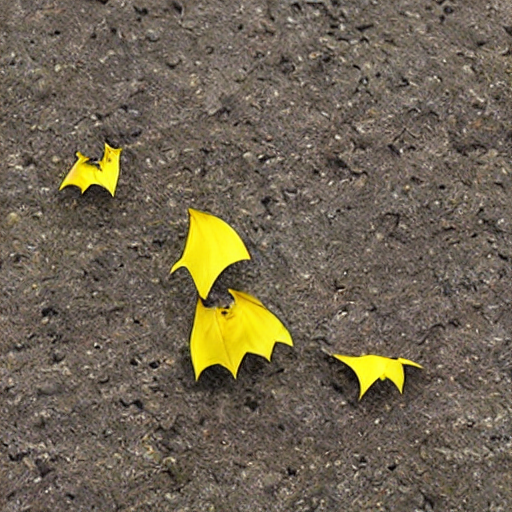
Banabats are small, flying creatures of the night best known for their bright yellow coloring and unique reproduction cycle. Banabats are friendly to most species and primarily feed on tree sap by using their sharp teeth to pierce deep holes through bark. While feeding, an enzyme in their saliva mixes back into the tree, fertilizing it. After a tree is fertilized, it will start growing a patch of typically 12-14 additional banabats sprouting directly from its branches.

Release Date August 27, 2022
Sign up for a free account to claim this creature as your own.

by NovelGens

Discover other creatures

Explore an endless universe of ficticious life on NovelGens.
COMMON

#064 Ytrail

Ytrail are large snail-like creatures found in frozen areas. Their shell is an immaculate conductor of heat, which keeps their body warm on even the coldest days. Domesticated ytrails are often ridden by small children to get to and from school an...

RARE

#162 Dansi

The dansi is a species of fish that can be found near the water surface in many areas of the world. They have an average length of fifteen inches and an average weight of thirty ounces. Dansis have a very flexible spine which allows them to make r...

RARE

#262 Ri-la-doch

Ri-la-doch are a species of sentient amphibious creatures that are somewhat similar to a large frog. Most are around three feet tall and covered in reflective, chromatically-aberrant skin. Like a frog, they are able to jump enormous distances and ...

COMMON

#221 Gormilgrimimrsa

Gormilgrimimrsa are tall, green, and lean creatures that live in the forest. They are extremely agile and can run for half a day on pure adrenaline, but can be very sensitive. To hunt, they use their keen sense of hearing to find prey, then use a ...

RARE

#225 Astorvega

An astorvega is a slow, lumbering creature covered in a thick, brown fur. It is roughly the same size as a bear and has large, powerful claws on its forelimbs that help it dig through snow or into small holes to sleep. The astorvega is a solitary ...

UNCOMMON

#284 Senjfisk

Senjfisk use thousands of microscopic limbs to move sand around them, enabling them to effectively swim through sand and loose dirt. These nocturnal carnivores also undergo a biological stasis while sleeping, which completely stops all but their m...