COMMON

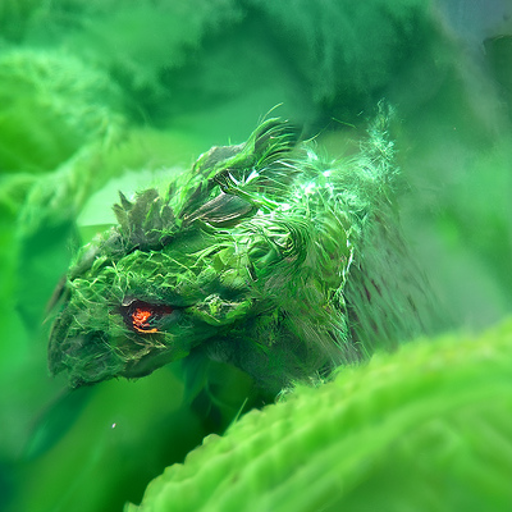
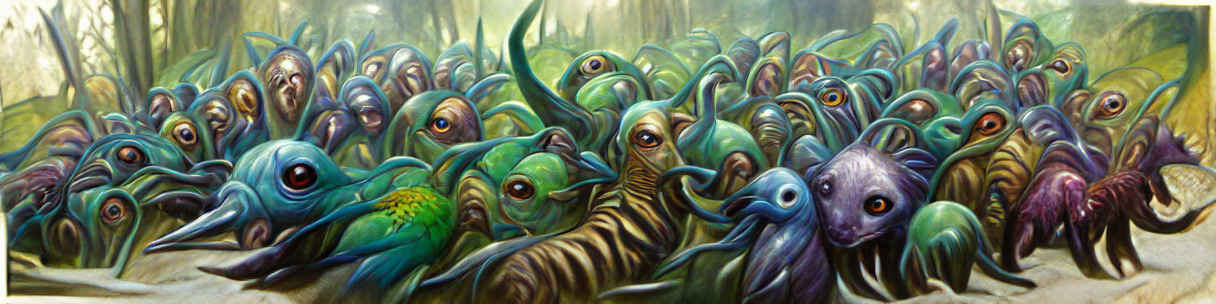
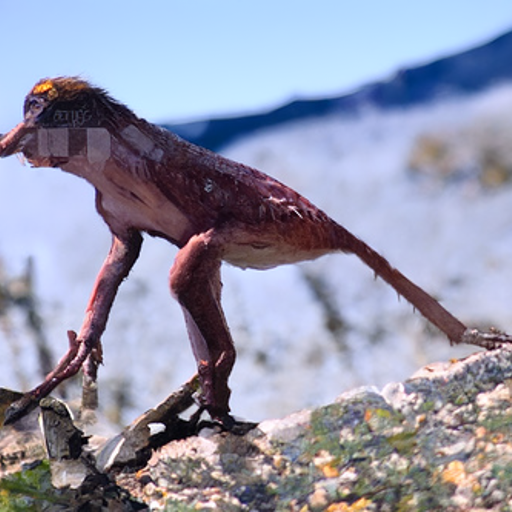
#025 Baibi

This small monkey navigates long distances by utilizing the bug-like wings on its back and can commonly be seen flying from forest to forest during the day. Their silhouette in flight mimicks those of birds, but birdwatchers with an eye for what to look out for claim it's a good omen to spot one.

Release Date January 21, 2022
Sign up for a free account to claim this creature as your own.

Discover other creatures

Explore an endless universe of ficticious life on NovelGens.

COMMON

#088 Fustonin

Fustonins are small, blue birds that live near active volcanoes. They are extremely light and can fly at speeds of up to 300 mph. They have no beaks and instead use the hard, pointed end of their shoulder to peck at the sides of a volcano and pry ...

UNCOMMON

#055 Kurobo

The charming three-legged kurobo walk isn't the only reason they caught the world's eye at their discovery. It's cute, yes, but the real mind-blower is their ability to manifest fire, seemingly at will. The blue fire burns hotter and brighter for ...

UNCOMMON

#251 Gorgolasa

Gorgolasas are giant carnivorous spiders with very sensitive eyes and hearing. They have a speed and agility comparable to that of a human, and they will often hunt in packs to bring down larger creatures. Despite their ferociousness, when humans ...

UNIQUE

#281 Mazurath

The mazurath are a class of giant serpentine creatures that have lived in the deep recesses of the ocean for millennia, if not longer. Mazurath are peaceful creatures but, due to their immense size, sailors often attack them after mistaking them f...

COMMON

#326 Kawa-tri

Kawa-tri are bulbous, tree-like creatures that live in forests. They thrive in the shade of other trees and grow much faster when they are standing near other kawa-tri. When a kawa-tri senses that it is in danger, its entire body will harden, effe...

COMMON

#351 Volly

Volly are sturdy, four-legged mammals that live on lush mountaintops, peacefully grazing on grass, flowers, and small mushrooms. Centuries ago, volly were almost entirely domesticated and bred for their restorative tears; over time, however, the h...