RARE

#277 Ka'ala'kai

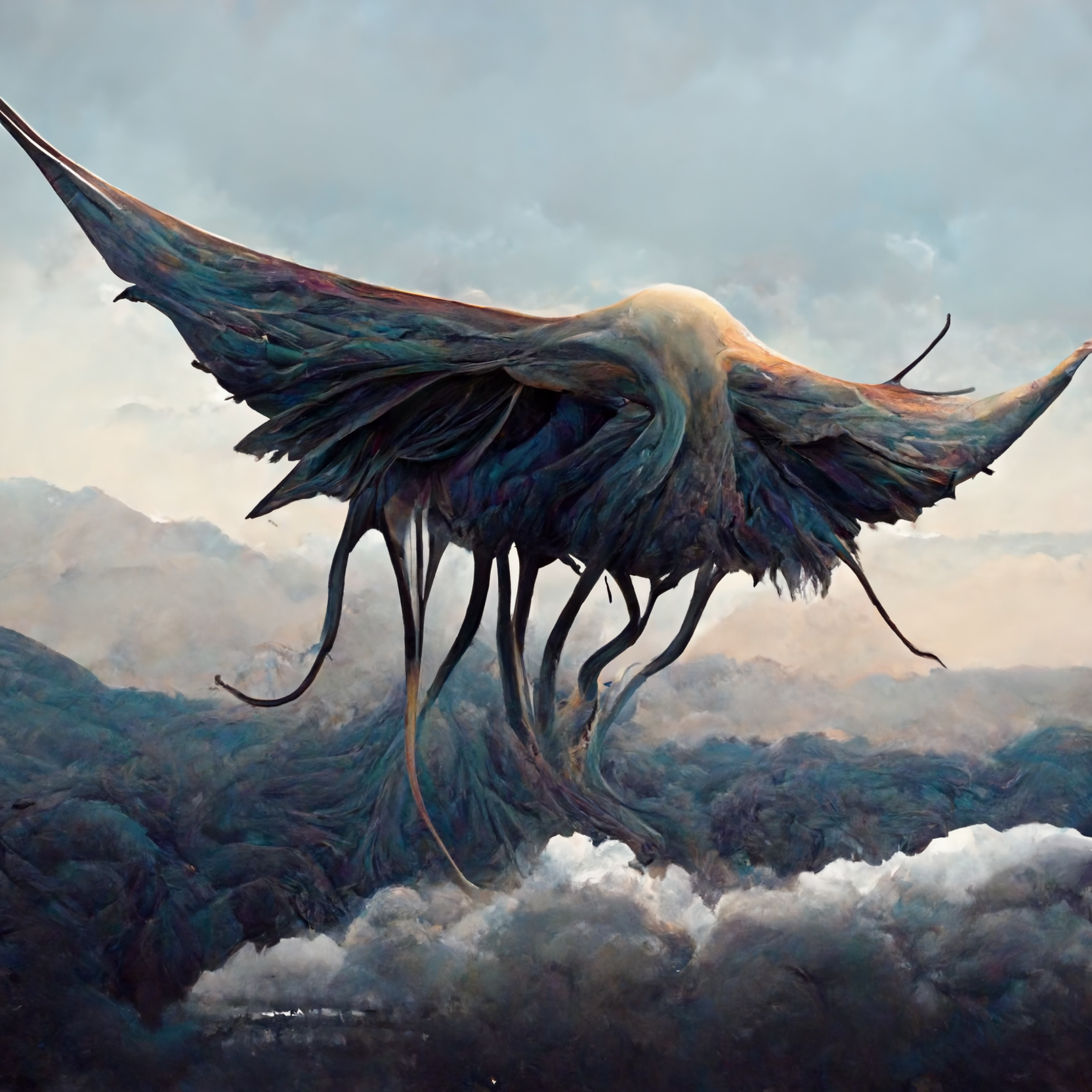
Not much is currently known about the ka'ala'kai. These gigantic, green creatures seem unaffected by life in a vacuum; their systems for mobility aren't yet completely known, as they seem to be able to ignore the effects of gravity (or no gravity) at will. So far, ka'ala'kai have only been sighted and recorded via long-distance telescopes pointed at abandoned planets, moons, meteors, and comets. Most sightings have corroborated the theory that ka'ala'kai are matriarchial nomads that travel from celestial body to body with their children, and that adult ka'ala'kai separate from the pack when they have children of their own.

Found in
Release Date September 30, 2022
Sign up for a free account to claim this creature as your own.

Discover other creatures

Explore an endless universe of ficticious life on NovelGens.
COMMON

#025 Baibi

This small monkey navigates long distances by utilizing the bug-like wings on its back and can commonly be seen flying from forest to forest during the day. Their silhouette in flight mimicks those of birds, but birdwatchers with an eye for what t...

COMMON

#141 Wartbug

The large wartbug is native to warmer forests on southern coasts, but has slowly spread throughout the continents over the years. They are about as large as a dog and primarily feed on berries and small forest-dwelling rodents. Wartbug shells are ...

RARE

#083 Weretree

When a werebeing sheds blood into groundwater, in some rare cases a nearby tree may absorb it and transform into a weretree. After around six weeks of transformation time, the weretree's bark feels rubbery; the branches grow large, meaty muscles; ...

COMMON

#266 Zajg

Zajg (spelled zayg in some locales) are a faceless fish common in warm reefs. These large trawlers use a version of echolocation that provides better information about their surroundings compared to typical fish eyesight. This sensory system allow...

UNIQUE

#341 Karystel

Karystels are noted for their beauty, grace, and quickness. Their long, lithe bodies move like eels, and they have scales in shades of iridescent purple, blue, and green. They are very popular in the arts, both among dancers and musicians. Baby ka...

COMMON

#358 Mollang

Mollang are small marsupials often found throughout wetlands and jungles. They live long lives despite the poisonous fungus that commonly grows on their short fur, which also protects them from most predators thanks to the highly-contagious nature...